

Indoor air quality (IAQ) has become one of the most important topics in residential HVAC over the past several years. The systems we install and service directly influence the air people breathe every day. Because many people spend most of their time indoors, HVAC professionals may have a greater influence on their everyday health than even their own doctors.
The challenge for us is not simply understanding IAQ — it is communicating it effectively so we can sell the right solutions that work. Advanced IAQ solutions can be difficult to explain to customers if we rely only on technical terminology. The key is presenting IAQ improvements through a clear framework that homeowners can easily understand.
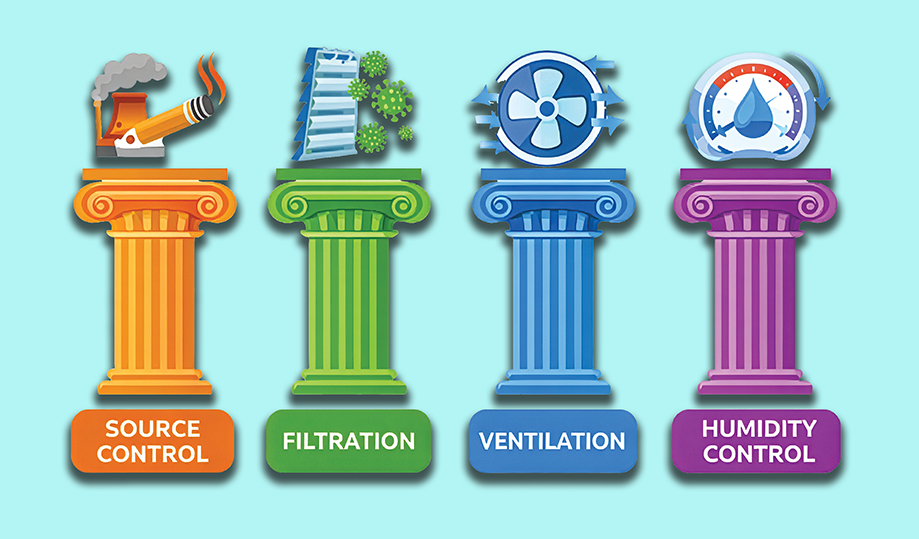
One of the most effective ways to communicate IAQ is through the concept of the four pillars of indoor air quality:
- Filtration
- Humidity control
- Ventilation
- Source control.
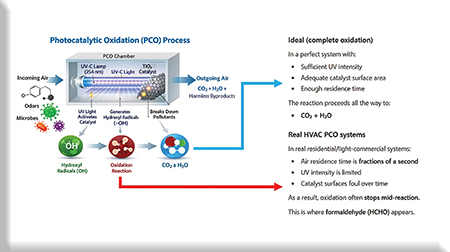
particulate matter from the airstream. Photocatalytic
oxidation is one method of filtering air.
Pollutants and their solutions can be organized into “buckets” so that what we sell is easy to explain and effective when implemented.
Pillar 1: Filtration — Controlling Particulate Matter
Dust consists of particulate matter (PM), including pollen, fibers, combustion particles, skin cells, and other microscopic particles suspended in the air.
We measure these particles in micrometers (µm). For perspective, a human hair is roughly 50 µm in diameter. The presence of larger dust particles on tables and floors indicates that smaller particles are also present, but unseen.
Particulate matter smaller than 2.5 µm (PM2.5) can pass through filters and penetrate deep into the lungs. Scientists associate these particles with a variety of health concerns, including respiratory irritation, cardiovascular stress, and other chronic conditions. The primary HVAC defense against particulate matter is air filtration.
How can you determine if there is a particulate matter problem in the house? Measure it! There are several good options for affordable, portable IAQ monitors with lab-grade sensors. These include:
Deploying these devices temporarily on every service call allows you to test the home’s IAQ while you’re there and advise your customers accordingly. Permanently installing a Haven IAQ monitor or even consumer-grade monitors such as Air Things View Plus can provide a larger sample size and a better view of the house’s overall IAQ needs.
Click Below for the Next Page:








Recent Comments