

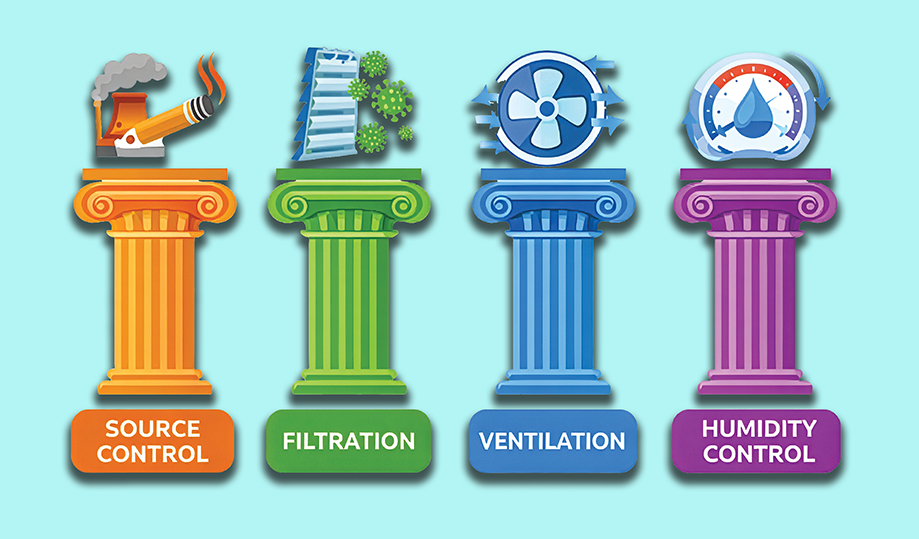
Filtration performance is not determined solely by the filter rating. MERV ratings are tested at approximately 300 feet per minute (fpm) face velocity. If a filter is undersized and the airflow velocity exceeds its rating, particles can pass through the media more easily. Therefore, proper filter sizing is essential when promoting filtration upgrades.
To better explain this to customers, try to frame filtration as a whole-system improvement, not just a filter change. A proper filtration upgrade may include:
- Installing a properly sized media filter cabinet and optimizing the return ducts
- Sealing duct leaks
- Verifying airflow and pressure drop after installation
- Adding a fan-powered bypass HEPA unit for additional particulate capture
- Installing a permanent IAQ monitor to verify results over time.
Pillar 2: Humidity Control — Managing Air Moisture
Humidity plays a critical role in IAQ. Too much moisture encourages biological growth and interactions with airborne chemicals, while air that is too dry can worsen respiratory irritation and allow particles to remain airborne longer.
When indoor humidity is too high, microscopic layers of moisture can form on surfaces, allowing mold and bacteria to grow. Research suggests that keeping indoor conditions below approximately 60% relative humidity (RH) and a dew point below 60°F helps prevent these conditions. You should be deploying psychrometers and hygrometers capable of calculating RH and dew point on every call, so data backs up your recommendations.
Many modern homes struggle with humidity because of oversized equipment or short cycling of properly sized equipment during mild, humid weather. When the system runs for only a short period, the coil does not remain cold long enough to remove sufficient moisture.
Beyond proper HVAC sizing, one of the most effective solutions is a whole-home dehumidifier. These systems can operate independently of the air conditioner and continue removing moisture even when cooling demand is low.
When promoting humidity solutions, contractors can emphasize the multiple benefits homeowners can experience:
- Reduced biological growth potential
- Improved comfort at higher thermostat settings
- Reducing the shrinking and expansion of wood surfaces.
Pillar 3: Ventilation — Diluting Indoor Pollutants
Chemical pollutants are too small to be captured effectively by a filter. These include gases such as carbon dioxide, radon, and volatile organic compounds (VOCs). Because we build homes more tightly now, these pollutants can build up.
We can measure pollutant levels using long-term IAQ monitors mentioned in the previous section. Then show the homeowner where their IAQ is now and quantify how much better you can make it.
The most reliable way to reduce indoor pollutants is through ventilation, which introduces outdoor air to dilute indoor contaminants, assuming outdoor air isn’t already polluted.
Ventilation strategies that work typically include installing:
- ERVs and HRVs (Heat Recovery Ventilators)
- Ventilating dehumidifiers.
Click Below for the Next Page:








Recent Comments