


The good news is that there’s a solution: a new, transformative technology: CX automation tools powered by generative AI.
Unification is Power
High-performance contractors need a single system to automatically pull together all customer data from across every touch point. Such a system can use AI to help understand and ingest all that data and provide contractors with key insights at a single glance.
Skimping on any part of this process can lead to failure. For example, an AI tool might summarize your texts, but if it doesn’t show what those same customers have said by phone (through transcriptions of calls) and email, it could lead you in the wrong direction.
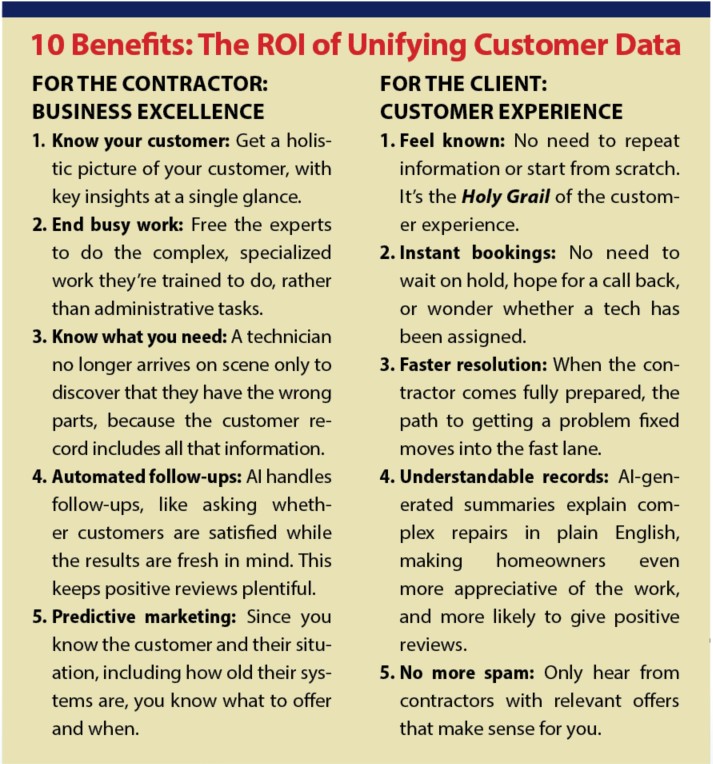
A Unified Customer Experience Management platform (UCXM) pulls together every action into a single record. It goes beyond just “omni-channel communications,” which leaves out the most important part: unification.
Unifying customer information gives a contractor a “perfect memory.” When a homeowner calls about a furnace blowing cold air, your team shouldn’t need to ask about the customer’s history, the type of system, or anything else that your company already knows.
Your team should instantly see all this, as well as how the customer felt about previous experiences; whether the customer gave your technicians a five-star review; and more.
Democratization of the Fortune 500 Experience
The same study I mentioned earlier, published in the Journal of Computer Science and Technology Studies, highlights the power of a unified customer data platform. In addition to establishing a “comprehensive data strategy,” it also increases cross-functional collaboration.
“While digital transformation requires significant investment, forward-thinking utilities recognize these expenditures as strategic rather than merely tactical,” the study says. “The value proposition encompasses multiple dimensions including operational efficiency, regulatory compliance, and enhanced customer relationships.
“Leading utilities are now prioritizing customer experience investments as part of their core business strategy rather than treating them as discretionary technology projects.”
Click Below for the Next Page:









Recent Comments