
What are the National Comfort Institute (NCI) Combustion Diagnostic Protocols? Or should we be asking, “How are/were these protocols created?” Another question might be “Why were they created?”
At NCI, we often get calls about the combustion operating ranges we developed protocols for new equipment, such as Mod-Con boilers, tankless water heaters, modulating or two-stage furnaces, etc. We don’t create them; we record what we measure, and they create themselves. The protocols are based on tens of thousands of hours of field tests over the last 40 years.

NCI combustion diagnostic protocols focus on ensuring safe and efficient operation by testing for proper draft and carbon monoxide (CO) levels. These protocols generally require CO in flue gases to be under 100 ppm and, often, CO air-free levels below 400 ppm for safety.
Key protocols include verifying draft (<-0.01 to -0.02-in. WC) and using combustion analysis to prevent hazardous venting or fuel-related failures.
Key Components of NCI Diagnostic Protocols
The following are five key components to these protocols, which include:
- Combustion Air Testing
- CO Levels
- CO Air Free
- Oxygen (O₂) Levels
- Draft Inspection.
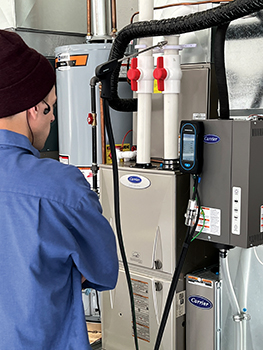
of flue gases in action on a
classroom furnace.
NCI also emphasizes that, in addition to testing, proper equipment service and maintenance are critical to safety.
So, why do we need these protocols? When we service equipment and measure O₂, CO, and temperature with a combustion analyzer, it is important to know what readings we should see. The only measurements taken by most combustion analyzers are O₂, CO, and temperature. All other readings on a combustion analyzer are calculations based on assumed conditions or values.
The one vital measurement for all vented equipment is the CO reading. Under normal operating conditions, CO readings should be below 100 ppm and stable. On rare occasions, the CO may be slightly above 100 ppm. Some instrument manufacturers’ specifications even list these slightly higher readings as OK as long as CO is stable.
These readings are acceptable and still far below industry protocols. The NCI listed O₂ and flue temperature ranges are not usually out of the box manufacturer specifications. These measurements or protocols are the final results of field adjustments to ensure equipment achieves its rated or best performance.
WARNING! DO NOT make adjustments until you properly control combustion air and venting, verify when that is done, and then measure with a combustion analyzer.
Click Below for the Next Page:










Recent Comments