
Ken Beasley is candid about what was happening in customers’ homes, as well. “Our guys weren’t even looking at the ductwork because they didn’t know that was important. We were simply selling like-for-like,” he explains.
The result: The Mission Critical team was installing equipment and charging customers a premium price, but mostly delivering subpar outcomes because, as Ken says, they did not consider the ductwork. He adds that they didn’t do airflow analyses and weren’t very good with load calculations.

When things didn’t work, he said they did what many contractors do first: look everywhere except the duct system.
“We wanted to blame the manufacturer. In one situation, it took a visit from our manufacturer’s field service rep to prompt a different conversation. On this one job, he told us we needed to take static pressure measurements. At that time, I had no idea what static pressure was,” Ken recalled.
“So the rep took the measurement and pulled a static reading of 1.2 in. He told me that pressure reading was the problem. But I had no idea how to fix that.”
But he soon learned how.
Exposure to High-Performance HVAC
Ken Beasley didn’t discover high-performance thinking through a single “aha” seminar. It was more like a trail of breadcrumbs — podcasts, peers, tools, and finally training.
“Watching Bryan Orr’s HVAC School channel was my introduction to National Comfort Institute (NCI) and what NCI was,” he said. “That was the starting point.”
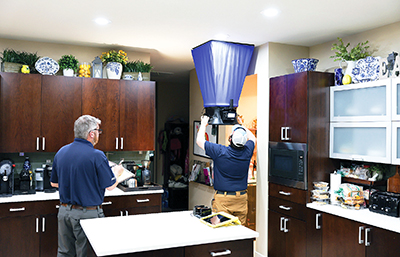
Here’s the part that surprised me: Mission Critical Comfort’s relationship with NCI is new. Ken didn’t take his first NCI class until January 2025.
“It was very much an eye-opener,” he said. Suddenly, that old “1.2 static” number had meaning — and became a path to correction.”
Ken described taking NCI’s Duct System Optimization (DSO) class and realizing that it wasn’t until he was on the six-hour drive back from Tampa that he truly had a revelation about what he’d learned.
“It wasn’t until I had some time for reflection that I realized what an amazing class that was.’”
Then he went all in. Ken sent techs to training, brought instructors onsite to train his entire team all at once, and started building a shared language around airflow, static pressure, and diagnostics.
“Most of my company is now DSO certified,” he told me, adding that a few newer hires haven’t had a class available yet. In other words, training isn’t a line item — it became part of the company’s operating system.
Click Below for the Next Page:







Recent Comments