


Frost Buildup and Defrost
In air conditioning, moisture in the air condenses onto the surface of the indoor coil, which falls off the coil and drains out. The coil should stay above freezing if the refrigerant charge and airflow are properly dialed in, so a frozen coil indicates a problem. That’s not the case for a heat pump in heating mode.
Heat pumps use a defrost cycle to melt frost on the coil. This cycle is controlled by a board and sensors, and it sends hot gas through the coil, just like in cooling mode. As you might imagine, proper airflow and refrigerant charge are crucial for melting that frost effectively.
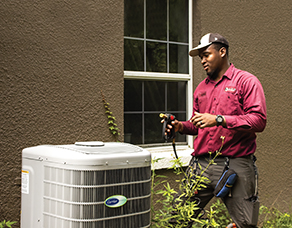
How Heat Pump Service & Maintenance Affect Defrost
A successful defrost cycle needs two things: enough hot refrigerant moving through the coils and adequate heat transfer.
Coil cleanliness matters again; impacted fins will make it harder for refrigerant heat to transfer to the frost surrounding the coil. The coil may not defrost completely, which leads to more frequent defrost cycles while the ice keeps piling up. Over time, the outdoor coil becomes a snow cube.
It’s the HVAC technician’s responsibility to make sure the coils are clean, the fan motor functions correctly, and the unit’s panels aren’t damaged. Outdoor units backed up against a wall or shrubs will have a harder time exchanging heat, as those can block airflow. The best we can do is discuss the situation with the customer.
In cold climates, you need to think about additional service considerations. Base-pan heaters at the bottom of the heat pump’s outdoor unit prevent melted ice from collecting at the bottom of the unit and refreezing before it can drain out. Refreezing can block heat transfer around the bottom row of the coil and even crush the tubing, causing refrigerant leaks.
If you work on a heat pump with a base-pan heater, check the resistance on the heater during scheduled maintenance and verify that water can drain out safely. This practice will go a long way to keep the heat pump running as it should when winter rolls around.
Knowing Where and How Heat Pump Refrigerant Flows
The key is to remember where heat pump refrigerant flows and what it’s doing at various points in the refrigerant circuit. Cooling mode is the same as in an air conditioner, so that’s half the battle.
The principles are all the same in heat mode. We know a dirty filter can cause low suction pressure in cooling mode, so why wouldn’t a soil and dog hair-packed outdoor coil do the same in heating mode?
Again, we can only make that connection by knowing where the refrigerant flows and what it’s doing in that other operating mode. Finally, remember that all of this is NOT rocket science. This approach may sound more intimidating than it is. It requires patience, training, and practice.
Roman Baugh is a commercial HVAC consultant and VRF specialist with over 19 years of industry experience, including 15 years focused exclusively on Variable Refrigerant Flow systems. He serves as Director of Commercial HVAC at Kalos Services and is the creator of the Troubleshooting Triangle methodology, featured at the HVACR Symposium and the 2026 AHR Expo. Among other projects, Roman hosts the VRF Tech Talk Podcast and VRFtechtraining.com, a training and resource hub for technicians working in the VRF space. To contact him, go to ncilink.com/ContactMe.









Recent Comments