


I’ll say, “If your doctor tells you your blood pressure is 197 over 131, you know something’s wrong. You need treatment — fast. Now imagine your HVAC system has a static pressure that’s 1.64 times higher than it should be. That system’s in trouble too.”
Communicate your field findings by sending the NCI Important Test Letter in a handwritten envelope. Why a handwritten envelope? So, your customers open the letter and don’t throw it away as junk mail.
How the Comparison Works
Most residential furnaces and air handlers are rated for 0.5 inches of water column (w.c.) total external static pressure (TESP). Through NCI research and thousands of field reports, we’ve found that the average system actually runs around 0.82-in. w.c.
When you divide measured static by rated static (0.82 ÷ 0.5 = 1.64), you get a multiplier. If you apply that multiplier to standard blood pressure (120/80), you end up with 197/131.
Now imagine explaining that to a homeowner:
“Your system is operating at a pressure that would be like a person walking around with a blood pressure of 197 over 131. They wouldn’t feel great, and neither does your equipment.”
When you use that analogy, you’re not talking over the customer’s head. You’re helping them visualize the problem in a way that feels real.
What High Static Pressure Really Means
So, what happens when a system’s static pressure is too high?
- Airflow drops
- Equipment runs hotter and longer
- Blower motors overheat and fail prematurely
- Coils freeze
- Compressors get “murdered,” not just “fail.”
I always tell technicians and salespeople: compressors and blowers don’t die — they’re murdered by poor airflow. And we’re often the ones pulling the trigger when we ignore the warning signs or decide not to measure because there is no time or we were never properly trained.
High static pressure is a symptom, not the disease. Your job is to find what’s causing it — restrictions in ductwork, undersized returns, dirty filters, restrictive coils, or poor transitions or system effect. Then, you need to give your customer clear options to resolve the issue.
The Static Pressure Budget: A Roadmap for Technicians
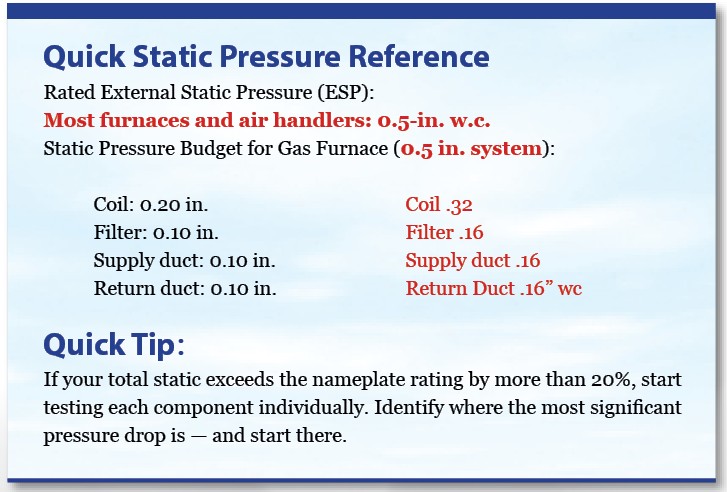
In commercial air balancing, engineers provide clients with the building’s required airflow and static pressure. But in residential HVAC, that’s up to you. That’s why NCI developed static pressure budgets for furnaces and air handlers. They’re not carved in stone, but they’ll get you into the ballpark.
For example, on a gas furnace system rated at 0.5-in. w.c.:
- 40% (0.20-in. w.c.) should be across the evaporator coil
- 20% (0.10-in. w.c.) across the filter
- 20% (0.10-in. w.c.) on the supply duct
- 20% (0.10-in. w.c.) on the return duct.
When you test and document these values, you can pinpoint which part of the system is choking airflow and explain it clearly to the homeowner. This process turns a “sales call” into an educational conversation.
Click Below for the Next Page:








Recent Comments