

Properly sizing a heat pump ideally begins with a room-by-room load calculation. This calculation reveals the home’s true heating and cooling requirements and guides us toward correct equipment selection.

In mild winter climates like those found in much of California, sizing is often straightforward because the cooling load is typically close to the heating load. But even in these climates, additional factors must be considered to ensure comfort, efficiency, and long-term performance.
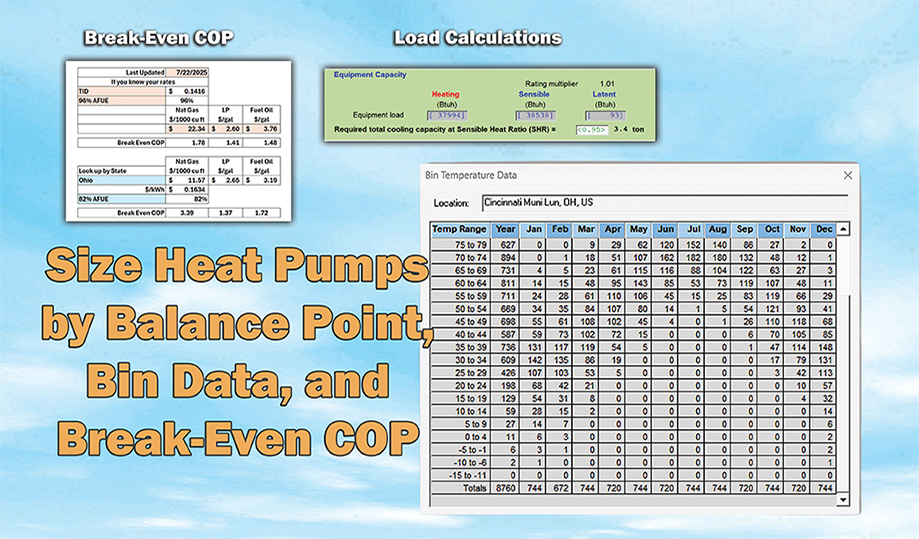
In colder climates, these considerations become even more critical. The Three B’s — Balance Point, Bin Data, and Break-Even COP — are essential tools for strategizing and properly sizing a heat pump to ensure reliable, economical heating throughout the winter.
Manual S instructs us to size equipment to the cooling load and use supplemental heat when the heating load exceeds the heat pump’s capacity. This is where the first of the Three B’s comes into play.
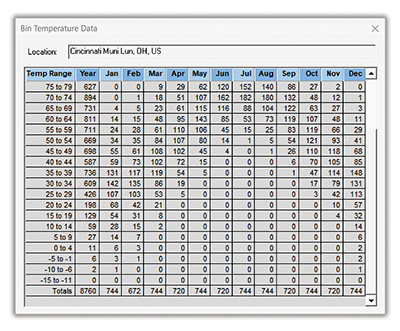
This data helps you determine whether you’ll need supplemental
heat for your heat pump designer whether a dual fuel
option is better.
Balance Point
The balance point is the outdoor temperature at which the heat pump’s heating output matches the home’s heat loss. At this temperature, the heat pump runs continuously and maintains the indoor setpoint without assistance.
Any drop in outdoor temperature below the balance point means the heat pump can no longer keep up, and the home will begin to cool unless you provide supplemental heat.
Supplemental heat is therefore essential below the balance point or during defrost cycles to maintain comfort.
A well-constructed home — with good air sealing, quality windows, and adequate insulation — will have a lower balance point. Balance point is a core principle of heat pump design: improve the structure first, then size the equipment. If the homeowner is unwilling or unable to address significant envelope deficiencies, a heat pump may not be the best solution.
For example, a home built in the 1930s with single-pane wood windows, no wall insulation, a raised foundation with no
floor insulation, and minimal attic insulation will have a very high balance point. Such a home may require significantly more heating than cooling capacity. Without improving the envelope, the system may require large supplemental heat strips or be better served by a furnace or a dual-fuel system.
Click the Link Below for the Next Page:









Recent Comments