

Many of us who have worked on traditional split air-conditioning systems have been utterly confounded by heat pumps. The refrigerant circuit runs backwards, the condenser and evaporator swap — what kind of sorcery is that? Where the heck do we hook up our gauges for service and maintenance?

In reality, it sounds a lot more intimidating than it really is. Static pressure and temperature split are the same as in an air conditioner. We just see changes in the refrigerant circuit, airflow between heating and cooling modes, and the defrost cycle, with a few extra things to consider in cold climates. The principles are the same, but the “what” and “how” differ a bit between heat pumps and straight-cool air conditioners. Those differences matter if we want to deliver the equipment’s best capacity.
Capacity Differences Between Operating Modes
A heat pump in cooling mode is no different from your typical air conditioner, but the refrigeration cycle gets turned on its head in heating mode. Craig Migliaccio (AC Service Tech) has some great books explaining precisely how this happens.
Since the indoor coil is smaller than the outdoor coil, it has a lower capacity in heating mode. For example, the indoor coil of a four-ton unit may be rated for 48,000 Btus in cooling mode for a set fan speed, but will move far fewer Btus in heating mode, without accounting for factors like ductwork issues.
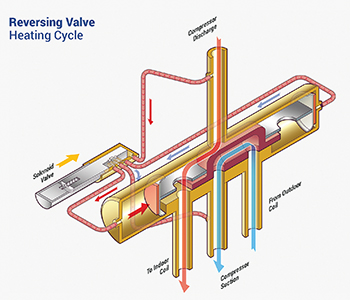
There are two strategies you can use to help the equipment to make up for the capacity difference in heating mode.
One strategy is to get more airflow across the coil. This will reject the hot, high-pressure refrigerant from the smaller coil with the same degree of heat exchange as you could expect in cooling mode. It’s common to run a heat pump at a higher fan speed in heating mode to help with heat rejection and distribution through the ductwork, especially in single- or two-stage equipment.
The other strategy, which you will find in communicating and inverter-driven systems, is compressor speed modulation. In those cases, the compressor adjusts its speed to maintain a target condensing temperature, which is the comparison of head pressure to saturation temperature.
Gathering Readings and Troubleshooting
Whenever I teach troubleshooting, I like to use the triangle method. This method requires you to plot three points in the refrigerant circuit: suction superheat, discharge superheat, and subcooling. Those three readings can tell us similar things in heating mode and cooling mode.
It’s easy to take temperature clamps and grab those three key measurements on straight-cool air conditioners or in cooling mode. But we can’t run a system in cooling mode just to check the charge on cold days, and those measuring locations all change in heat mode. It IS possible to check the charge in heating mode, if we know what’s happening inside the system.
Click Below for the Next Page:










Recent Comments