

When you’ve been in the trades as long as I have — since I was 11 or 12 riding along in a plumbing truck with my foster father — you learn that precision matters. Whether it’s installing a water heater, roughing in plumbing for a remodel, or designing a High-Performance HVAC™ system, accuracy is everything.
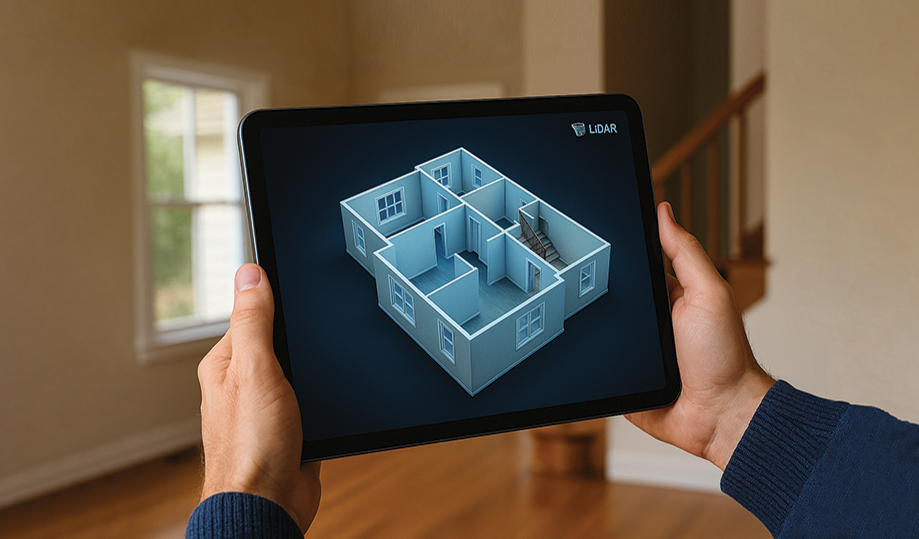
Fast forward to today: I’m 34, and as a Home Solutions Specialist at Basnett Plumbing, Heating, AC & Electrical in Littleton, MA, I’ve seen firsthand how technology can revolutionize the way we work. One tool in particular — LiDAR-based scanning — has changed our approach to load calculations, system design, and customer experience.

Some History and Background
Basnett has been serving homeowners since 1987. Our focus is primarily residential work, with some light commercial sprinkled in. We handle plumbing, heating, air conditioning, electrical, and indoor air quality products like air and water filtration.
Most of our projects are retrofit and replacement jobs; we try to stay away from new construction because it’s not our sweet spot.
What sets us apart is our high-performance approach. We don’t just throw in equipment and hope for the best. In fact, our team asks the right questions, digs into homeowner motivations, and applies building science principles. We use ACCA-approved methods — Manual J, S, and D — and we insist on the best parts and materials.
That’s been our philosophy for years, and it’s why our reputation in the marketplace is strong. But even with that commitment, traditional methods had limitations. That’s where LiDAR came in.
The Birth of a Better Tool
We first encountered LiDAR technology a few years ago, when one of the founders of Conduit Tech approached us with an idea for remote monitoring of AC condensers. Conduit’s co-founder Marisa Reddy spoke with our owner, Rob Basnett, who wasn’t sold on that concept.
Instead, he told her we really needed a better way to do Manual J calculations. That conversation helped to spark the development of Conduit Tech’s LiDAR-based scanning tool.
We got involved from the early design and development stages by giving feedback, beta testing, and pushing for improvements. I personally refused to adopt it until it could match the accuracy of Wrightsoft’s Manual J program, which had been our go-to for years. Eventually, after countless tweaks, the software hit that mark. In May of 2025, I did my first scan with Conduit Tech, and I haven’t looked back since.
Why LiDAR? Accuracy Above All
If you’ve ever done a Manual J by hand or even with traditional software, you know the drill: measure every window, every wall, every ceiling height. Input all that data, then wait for the program to crunch the numbers. It’s tedious, and it leaves room for error. LiDAR eliminates that.
Click Below for the Next Page:






It eliminates it for $6k++ a year, and then you have to do manual d,s, etc
Too expensive at this point
Kwik Model 3D is the only Manual J load calc app that can import a LiDAR scan and do Manual D duct design. It can also import 2D new construction floor plans and Cubi.Casa floor plans. Also, once imported, the 3D model is fully editable. You can easily add or delete walls, rooms, windows, vaulted ceilings . . . anything.