

How and Where to Take Readings in Heating Mode
The reversing valve complicates everything in a heat pump. It’s usually located within eighteen inches of the compressor.
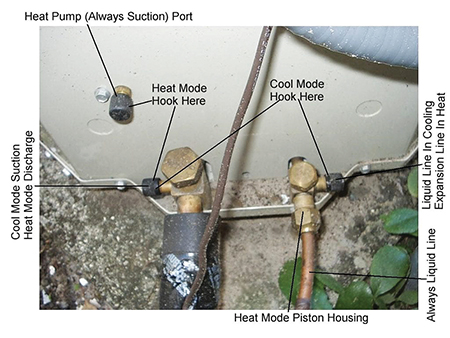
Regardless of operating mode, the top tube will always carry discharge gas, and the bottom middle tube will always direct suction gas out. Therefore, heat pumps will have an “always suction” port that connects to the bottom middle tube exiting the valve.
If you use a temperature clamp to collect the suction line temperature, stick it closer to the compressor inlet than the reversing valve, as discharge gas inside the valve may inflate the temperature reading.
In heating mode, discharge gas runs through the cool-mode suction line, so the larger vapor service port will actually give you the system’s head pressure in heating mode. You can collect the discharge temperature with a clamp six inches out from the compressor outlet.
The smaller tube will carry warm, high-pressure liquid in heating mode and can help you determine subcooling. Be careful about using the smaller liquid service port to collect head pressure readings. If it’s after the metering device, the refrigerant will be a low-pressure liquid-vapor slurry.
Kalos technicians use measureQuick® to capture these readings, which also provides performance indicators to show which readings are high or low and whether the system is meeting its capacity. We don’t hook up gauges on every single maintenance because refrigerant losses add up, but we always do it on the first maintenance to create a benchmark.
How Proper Maintenance Sets Heat Pumps Up for Success
Heat pump maintenance looks very similar to air conditioner maintenance in terms of checking the charge, airflow, and cleaning. We always record refrigerant temperature and pressure readings, temperature split, and static pressure with measureQuick.
Technicians screenshot the readings and upload them to the system’s profile in our company software.
Our maintenance plan also covers several electrical considerations and readings. It includes a visual inspection of the capacitor, contactor, and wiring connections and splices, and our technicians measure amp draw on the indoor blower motor, compressor, and outdoor fan motor.
Cleaning the outdoor coil is crucial for heat pumps. We’ve all seen head pressure because of filthy, impacted fins on the condenser coil. Just as dirty filters and coils can cause low suction pressure in air conditioning, an impacted outdoor coil can do the same in heating mode. TXVs and EEVs modulate to maintain a set superheat, and if they can’t do that effectively, the heating capacity takes a nosedive.
Our technicians also check the indoor coil, blower, drain, visible ductwork, and cabinet panel condition. The highest pricing tier includes blower wheel cleaning; otherwise, we quote to pull and clean it if there is notable soil. We include coil and drain cleaning with water and Refrigeration Technologies cleaners in all maintenance plans. We also include air filter replacement.
Kalos’s maintenance plans cover cooling and heating modes, with heating mode primarily being tested in the fall. Heat mode maintenance includes checking the amp draw on the electric heat strips, which activate during the defrost cycle on the rare occasion it gets cold enough in Florida. We want to make sure the amperage is appropriate for the heater’s rated wattage and that there are no apparent electrical safety issues.
Click Below for the Next Page:









Recent Comments