

However, we have found that sealing the envelope and insulating the attic are relatively inexpensive upgrades that dramatically improve heat pump performance while lowering the balance point.
Climate also plays a major role. A home in coastal California will have a very different balance point profile than a home in the Sierra foothills. Climate leads us to the second “B.”
Bin Data
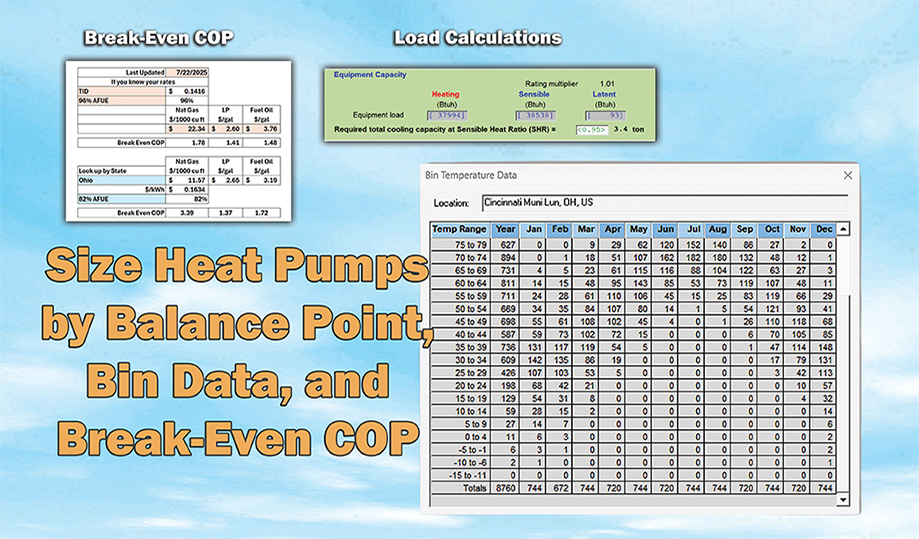
Once the balance point is known, the next step is to analyze bin data. Bin data is statistical weather information that groups outdoor temperatures (and sometimes humidity) into specific ranges, or “bins,” showing how many hours per certain condition occur. You use bin data for calculating building energy use more accurately than simple averages. This information is essential for determining:
- Whether supplemental heat is needed
- How much supplemental heat is required
- Whether dual fuel may be a better option
- How often the heat pump operates below its balance point?
For example, if the balance point is 32°F but the bin data shows only 20 to 40 hours per year below that temperature, the home may need some supplemental heat. In some climates, heat strips may energize only during defrost cycles.
Because of our mild climate, we rarely install supplemental heat strips on the systems we install. It’s simply not necessary.
In addition, we use variable-speed heat pumps that run at low speeds most of the time and thus rarely go into defrost, if at all.
However, if the bin data shows hundreds or even over a thousand hours below the balance point, the heat pump will struggle for long periods. In these cases:
- Supplemental heat will run frequently
- Operating costs may increase
- Comfort may suffer if supplemental heat is undersized
- Dual fuel may be a more cost-effective and reliable solution.
Bin data also helps us size supplemental heat strips correctly. Oversizing strips increases electrical demand and installation cost, while undersizing leads to callbacks and comfort complaints.
Bin data provides the “how often” and “how long” information needed to size supplemental heat intelligently.
Once you have this information, it’s time to consider the third “B:”
Break-Even COP (BECOP)
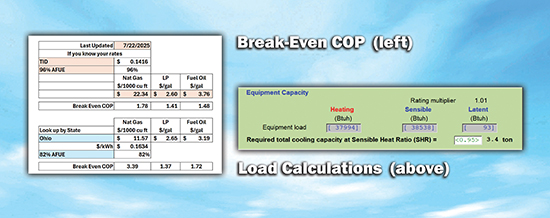
The Break-Even COP, or BECOP, introduces the economic side of heat pump operation.
BECOP identifies the outdoor temperature at which it becomes more expensive to run a heat pump than a furnace in a dual-fuel system.
The question you need to ask yourself is: At what temperature does the furnace become cheaper to operate than the heat pump?
BECOP depends on four factors:
- The home’s balance point
- The home’s thermal glide (how quickly heat loss increases as temperatures drop)
- The cost of electricity versus gas
- The efficiency of the heat pump at various outdoor temperatures.
If electricity is expensive and gas is inexpensive, the BECOP may be relatively high. If electricity is cheap or the heat pump is highly efficient, the BECOP may be very low.
Click Below for the Next Page:









Recent Comments