


We also developed a flat under-the-door probe that attaches to a painter’s pole, allowing technicians to read room pressure without kneeling. Considering the average age of HVAC techs is pushing 60, I’d call that a necessary ergonomic upgrade.
Sometimes the simplest innovations make the biggest difference.
COVID Changed Everything About Ventilation
When COVID hit, buildings faced a reckoning. ASHRAE’s Building Readiness Committee emphasized one thing above all: The need to increase outdoor air.
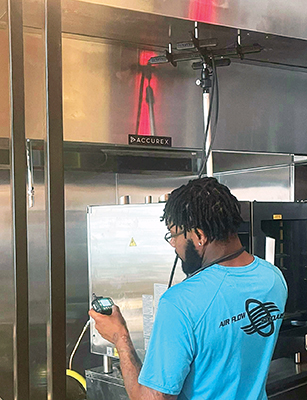
hood to ensure airflow and air balancing
is up to specification.
The data that emerged was startling:
- Theaters needed six to eight air changes per viewing, according to a Japanese study used by the National Association of Theater Owners
- The NFL Players Association required certified TAB reports showing four air changes per hour before players would return
- Touring productions like Hamilton and Book of Mormon refused to perform until TAB verification was completed at every venue
- The Philadelphia school district was sued; nearly 78% of its outdoor air systems were found to be non-functional
- An NCI study of 786 systems nationwide found 83% of outdoor air systems weren’t working.
The numbers told the same story nationwide: our buildings weren’t providing adequate ventilation even before the pandemic.
COVID just exposed it.
Restaurants: Balancing Failures
If you want to see pressure issues, go to a restaurant. Many times, you practically need to body slam the front door to get inside. That’s more than just a nuisance:
A restaurant door MUST NOT require more than 30 pounds of pull force, or it’s a fire code violation. I’ve seen doors at 50 pounds.
Negative pressure can also:
- Snuff out pilot lights
- Pull dirt directly into kitchens
- Skyrocket utility bills
- Violate health codes.
One Texas restaurant with oversized replacement exhaust fans pulled DOUBLE the intended airflow — 12,000 instead of 6,000 cfm. They had seven days to fix it or shut down. True story.
Most of these problems stem from incorrect design, poor installation, or un-engineered equipment changes. For example, moving a deep fryer just two inches brought an entire school’s kitchen exhaust system back into compliance. Two inches.
Little things matter.
Commercial TAB Requires Training and Knowledge
Residential balancing is important — fan speeds, duct adjustments, static pressure — but commercial and industrial work introduce entirely new worlds:
- Kitchen hoods
- Makeup air units
- Plenum exhaust systems
- VAV systems
- Fume hoods/bio-safety cabinets
- Dust collection systems
- Medical isolation rooms
- Operating theaters
- Clean rooms.
Each environment has its own requirements, air change expectations, pressurization codes, and instruments. Medical rooms, for example, must maintain specific airflow and typically a pressure of 0.01 inches, though many hospitals operate at 0.015 to 0.03.
Click Below for the Next Page:





Recent Comments