

I’m guessing you would like to stand out in your marketplace, not just as the go-to contractor for High-Performance HVAC™ retrofits and renovations, but as the preferred high-performance service company.
People often ask me, “what makes high-performance service different?” My answer is, Everything.
Starting from even before entering a home to how you spend your time there, you have a chance to demonstrate your differentiation and value — whether on a demand-service call or maintenance visit.
Everything you do can be different from your competition and you can provide tremendous value for your customers in terms of safety, health, comfort, and energy efficiency.
On demand-service calls, it means doing some additional testing on their system after solving the immediate issue. This might include measuring static pressures and delivered airflow, and checking for proper combustion and carbon monoxide (CO) safety.
This article could go on for three pages just on how you can apply these principles to demand service calls and ethically increase your average ticket. Unfortunately, I have limited space so I’ll save that conversation for another issue.
Let’s begin by comparing high-performance maintenance agreements to basic clean and checks.
Basic Clean and Checks
Most contractors market “clean and checks” as 18-point inspections (or something like that). These “maintenance” services usually include some visual inspections, and probably some basic temperature readings.
A maintenance visit might include examining and a light cleaning of the condensing unit, and inspecting the contactor, capacitor, etc.
It might include inspecting and replacing the filter, looking for condensate drain issues, flue problems, and visual signs of combustion issues.
While important, this typical service level only gives you a partial picture of what might be going on with their HVAC system.
High-Performance Maintenance
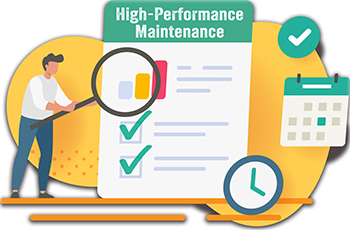
On a high-performance maintenance visit, the technician still does all of the above — but that’s where the similarities stop. High-performance maintenance includes measuring static pressures — typically in four places. Then the technician either interprets airflow through TESP (Total External Static Pressure) or measures it directly at the equipment with a TrueFlow™ grid.
Additional testing typically includes measuring supply and return air dry and wet bulb temperatures, and checking for CO in the home and around combustion appliances. If you really want to do it right, you should also check draft and CO levels in the equipment flue.
Establish a Baseline
The benefits to spending the extra time testing are two-fold: First, you are helping to make sure the home is safe, and the equipment is operating as it should. If it isn’t, you can bring the issues to the homeowner’s attention and suggest ways to improve things. The improvements can be done all at once, or they can be staged over time.
Second, once everything is working properly, you can establish a performance baseline. On the next visit you can quickly test against these baseline numbers to see if anything has changed.
This approach allows you to include not just the equipment but the entire air distribution system in your maintenance agreements.
Click Below for the Next Page:






Recent Comments